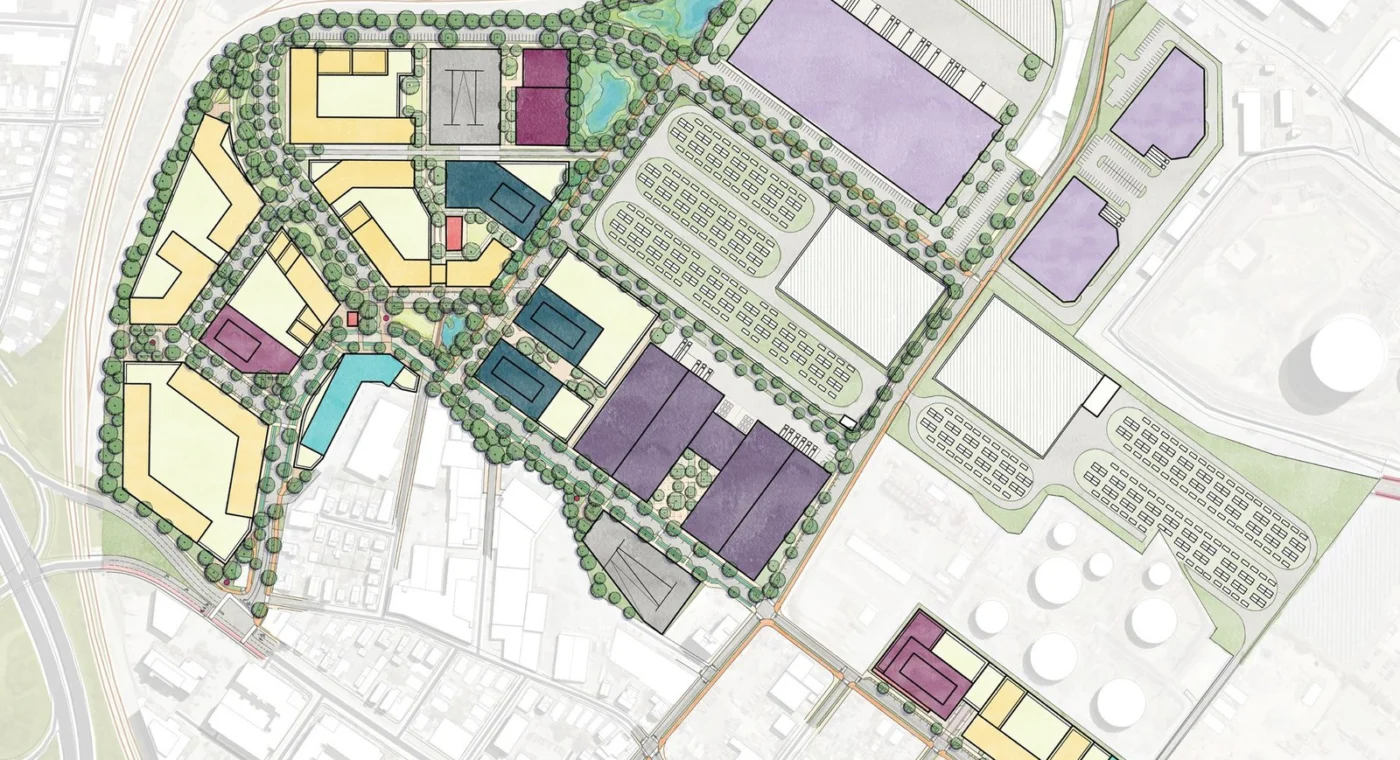
The largest development ever proposed in Everett went back to the starting line on Monday night, at least on paper. The Planning Board voted 4-0 to let Everett Landco, the Davis and Global Partners venture that owns the 106-acre former fuel terminal at 52 Beacham Street, withdraw the master plan special permit it filed in April 2025 and open a fresh public hearing on a resubmitted version. The board then continued the new case to its December 7 meeting without taking testimony from anyone who favored it.
Planning Director Matt Lattanzi told the board why the paperwork had to be reset. Under the board’s rules a member who misses one meeting of a public hearing can still vote after listening to the recording, but a member who misses more than one cannot vote at all. Over the 18 months the Docklands application had been open, Lattanzi said, four of the board’s seven members had missed more than one meeting. Reintroducing the plan as a new item, numbered PB2026-18, makes every member eligible again. It was the third time the project has been introduced as a new piece of business.
Ben Masselink of Davis said the night was the company’s 16th hearing before the board and happened to fall on the same day it filed its final environmental impact report with the state.
What the resubmission asks for
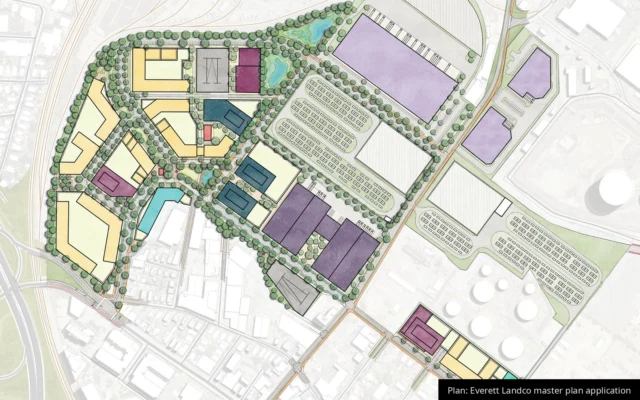
The October 19 resubmission, a 128-page document posted in the board’s online packet, asks for up to 4,996,900 square feet of buildings on 106.34 acres, not counting parking. The program table breaks that down as 2.4 million square feet of housing, 1.4 million of lab and office space, 400,000 of industrial, 254,000 of high-tech manufacturing, about 229,000 of retail, about 228,000 of hotel space and 85,900 of maker space, with a cap of 5,260 parking spaces. The benefits section promises up to about 2,700 housing units, more than $3 billion in private investment, more than $20 million a year in new property taxes, 1,500 construction jobs a year over 15 years, 7,000 permanent jobs, roughly 8,500 linear feet of new public roads, 15 acres of open space and about 400 trees on land that today has none.
Masselink said the company has committed to passive house standards for every residential building, a reference to an earlier agenda item where a Ferry Street developer noted that passive house is not required in Everett. He said Davis has been working with National Grid since it bought the site at the end of 2023 to bring in a new substation, because the district is “woefully underserved with power,” and that the company recently agreed with the state to put $12.5 million toward extending the Silver Line.
Melissa Schrock, Davis’s managing director of development, said the extension would run from Chelsea through Lower Broadway to Sullivan Square, and that a new commuter rail station is also planned, with the casino having pledged $25 million toward it. She said nearly 50 above- and below-ground tanks and 20 miles of piping have been removed since the end of 2023, and that the soil now being trucked in is raising the site out of the flood plain. The company hopes to start its first buildings by the middle of 2027.
The phasing table in the application puts three buildings in that first phase: a 200,000-square-foot industrial building on the east side of the site, a 377-unit apartment building with 64,640 square feet of retail where Bartlett Street meets Broadway, and a 254,000-square-foot advanced manufacturing building at the corner of Beacham and Robin streets. The application lists delivery dates of 2028 for the industrial and manufacturing buildings and 2029 for the apartments, and notes that the schedule “may change as market conditions evolve.” Each building would still need its own site plan approval from the board.
The data center question, again
The use table in the resubmission lists “Data Center” under research and development, with an asterisk. That drew the sharpest comments of the night.
One board member read a string of page numbers from the application back to the developers: page 6 on sustainability and environmental equity, page 8 on Everett as an environmental justice community, page 92 on reducing carbon output in line with city and state goals. “If you’d like it to be in alignment with the city’s goals, I’m having a hard time understanding the lack of willingness to align yourself with the updated zoning for the city regarding data centers,” the member said, citing noise, air quality, water use during a multi-year drought and the effect of utility upgrades on residents’ rates. “I’m going to have a really hard time believing any of what’s in this master plan special permit touting respecting Everett’s environmental justice community if you’re not getting in line with what the community and our representatives have already outlined to you.”
The City Council rewrote its data center rules in June to allow centers under 20,000 square feet and 5 megawatts by special permit and ban anything larger, and made the ordinance law on a 9-2 vote on June 22. Davis had lobbied the council for a looser cap during that debate.
“We have no plans to build a data center. We never have had plans to build a data center,” Masselink answered. He said the company’s goal during the ordinance fight was to keep the option open “if it came and there was value to the community,” and offered to write every provision of the adopted ordinance into the special permit so that the company would be bound by it. The reason to keep a data center in the use table at all, he said, was so that if “Google, IBM, the Broad Institute, some other research institute” wanted to come with thousands of jobs and a 30,000-square-foot data center attached, the board could hear the proposal and decide. “If it’s not worth it, it’s not,” he said.
A resident who gave his name at the microphone as Jeff Parr spoke against the petition. He said he had only skimmed the 128 pages but had seen data centers listed under research and development, called the use a liability for the city on environmental grounds, and pointed to recent hacking incidents and talk of an artificial intelligence investment bubble. No one spoke in favor when the chairman, Frederick Cafasso, asked three times.
Grading, ponds and a redline
A representative of the owners of 152-168 Beacham Street asked how the final grading plan would affect those parcels. Masselink said Beacham Street rises to about elevation 30 on the east side of the Davis land while parcel D is being graded to about six and a half feet, so the parcel sits below the street and drains inward to detention basins and out through an existing culvert to the Island End River rather than shedding water toward the neighbors. He promised to send the grading plan over.
Asked whether the two detention ponds near the industrial parcels would be usable green space, Masselink said they fill during major storms and drain afterward, and would be ringed by landscaped walkways as part of the public open space. A board member asked whether heavy industry, generators and noise next door would spoil the enjoyment of that space. Masselink said the ponds had to be near the culvert because of the grades, and that heavy industrial uses are allowed on the east side but not guaranteed to be built there.
A board member who said they had read the document “line by line multiple times” asked for a redlined version showing every change from the 2025 filing. Masselink agreed, and also agreed to share the Harvard Kennedy School study of the district and the 2022 master planning work the city commissioned from the firm Utile.
Earlier in the meeting the board also continued, to December 7, Davis’s request for endorsement of a definitive subdivision plan dividing 88.6 acres of the site into 12 lots with 1,344 feet of roads. Lattanzi said the city is still doing due diligence on that plan and is bringing on an outside consultant to review it. In closing remarks he told the board to expect special meetings in 2027 for “these massive projects,” naming the Davis land and the stadium.
The full resubmission and appendices are in the board’s November 2 packet folder. The meeting video is on the city’s YouTube channel; the Docklands item begins at about 32 minutes.
Read our full transcript of the November 2 Planning Board meeting.